
Supermarine Spitfire
R. J. Mitchell’s celebrated fighter evolved from a Merlin-powered interceptor into a wide family of wartime and postwar aircraft.
For information on this aircraft, please click here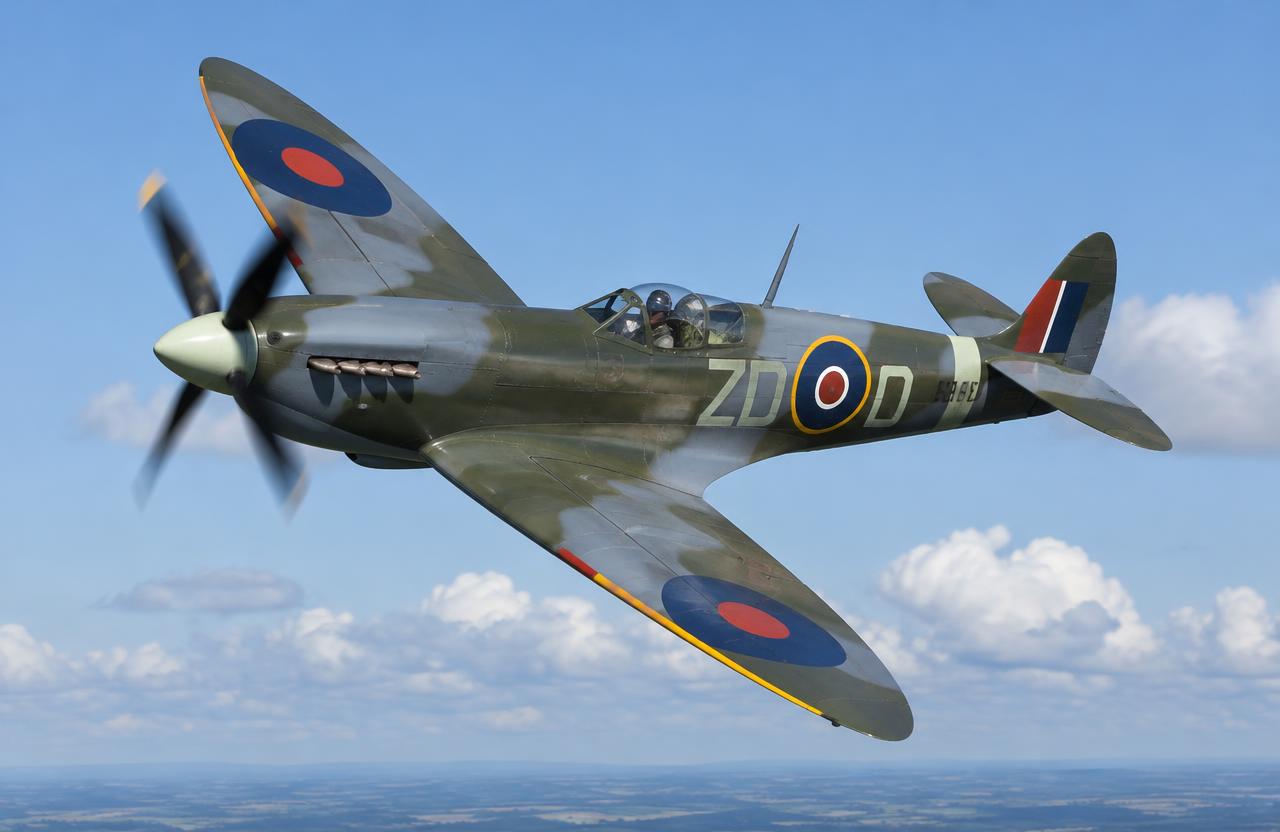
- Manufacturer
- Supermarine
- First flight
- 5 March 1936
- RAF introduction
- August 1938
- Role
- Fighter / photo reconnaissance
Mitchell’s design
Reginald J. Mitchell and the Supermarine team drew on experience gained with high-speed Schneider Trophy seaplanes, though the Spitfire was a new military design rather than a racing aircraft put into service. Its thin elliptical wing, enclosed cockpit and retractable landing gear combined aerodynamic efficiency with the demands of a modern fighter.
The prototype first flew on 5 March 1936. Early versions used the Rolls-Royce Merlin V12 engine. In August 1938, No. 19 Squadron at Duxford accepted the first operational Spitfires, beginning the type’s long association with the RAF.
The Battle of Britain and beyond
During the Battle of Britain in 1940, the Spitfire became a symbol of RAF resistance. It fought alongside the more numerous Hawker Hurricane, rather than winning the battle alone. Speed, manoeuvrability and continued development made it a capable opponent of the Messerschmitt Bf 109.
Spitfires subsequently served across numerous theatres, including the Mediterranean and Asia. Beyond air combat, specialised photo-reconnaissance versions used cameras and range improvements to gather intelligence. Different roles demanded changes in equipment, wings, armament and fuel capacity.
Continuous evolution
The aircraft changed dramatically through successive marks. More powerful Merlin engines were followed by Rolls-Royce Griffon engines in later versions, while wing and armament arrangements evolved from early machine-gun installations to cannon-equipped fighters. Some versions had clipped wingtips or revised rear fuselages and canopies.
Development spanned the early Mk I through the Mk 24, and more than 20,000 Spitfires were built. The related Seafire adapted the design for naval operations, adding equipment such as an arrestor hook for carrier landings. Not every Spitfire therefore has the same wing outline, engine or cockpit appearance.
Postwar service and preservation
The Spitfire continued in service after the Second World War, both with Britain and overseas air forces, before newer fighters replaced it. Preserved aircraft now appear in museums, memorial flights and air displays. Restorations and temporary maintenance change the number able to fly, so a fixed worldwide airworthy count soon becomes outdated.
What to look for
The elliptical wing is the classic clue, but clipped-wing examples also exist. Check the nose length, exhausts, propeller and canopy to help distinguish marks. Merlin and Griffon variants can look and sound different; markings alone do not establish an aircraft’s wartime identity.