
McDonnell Douglas MD-80
From the DC-9 Super 80 to a familiar airline workhorse: the story of McDonnell Douglas’s stretched, rear-engined jet family.
For information on this aircraft, please click here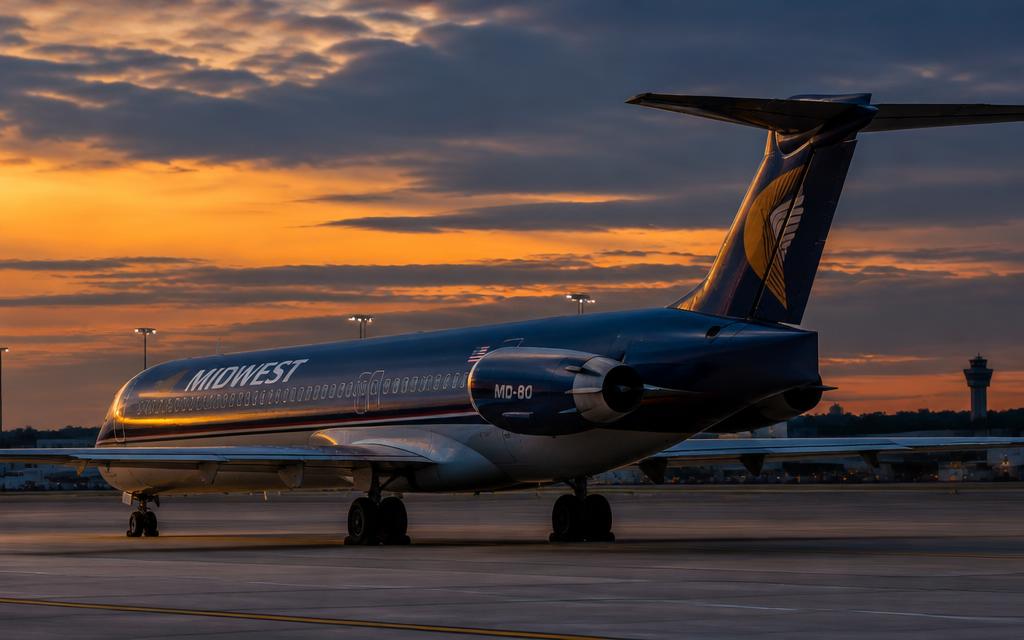
- Manufacturer
- McDonnell Douglas
- First flight
- 18 October 1979
- Entered service
- October 1980
- Role
- Short / medium-haul airliner
Origins: stretching the DC-9
The MD-80 grew out of the Douglas DC-9, a compact twin-engined airliner designed for frequent flights between smaller cities. As airlines wanted more seats without moving to a wide-body aircraft, McDonnell Douglas developed a longer fuselage, a revised wing and more powerful Pratt & Whitney JT8D engines. The new aircraft retained the DC-9’s five-abreast cabin, rear-mounted engines and T-tail.
Initially called the DC-9 Super 80, the aircraft first flew on 18 October 1979. FAA certification followed in August 1980, and Swissair introduced it into airline service that October. The MD-80 name subsequently became the identity of the family rather than a single version.
The family and its design
The principal versions were the MD-81, MD-82, MD-83, MD-87 and MD-88. The MD-82 offered greater engine power for demanding airport conditions, while the MD-83 added longer-range capability. The MD-87 had a shorter fuselage, and the MD-88 introduced an electronic flight-instrument system and other updates.
Placing the engines behind the passenger cabin gave the aircraft a distinctive profile and kept much of the wing clear of engine nacelles. Its older-generation JT8D engines also gave it a recognisable sound. These design choices made the aircraft visually and acoustically quite different from later underwing-engined narrow-body jets.
Airline service
The MD-80 became a familiar sight across North America and Europe, carrying passengers on high-frequency domestic and regional routes. Airlines including American Airlines, Delta, SAS and Alitalia operated substantial fleets. Its combination of capacity and established DC-9-family technology made it a practical aircraft for decades of scheduled service.
As newer aircraft offered lower fuel consumption and quieter operation, major airlines gradually replaced their MD-80 fleets. Some aircraft continued with smaller operators or in specialist roles. A surviving example is therefore an increasingly unusual find compared with the type’s years as an everyday airport visitor.
Production and legacy
Production ended in 1999 after 1,191 MD-80 deliveries. The aircraft’s lineage continued through the MD-90, which used newer engines, and the smaller MD-95. After Boeing and McDonnell Douglas merged in 1997, the MD-95 became the Boeing 717. Together, these aircraft illustrate how the original DC-9 concept evolved across several generations of airline flying.
What to look for
Look for the long, slim fuselage, two rear-mounted engines and high T-tail. The MD-87 is noticeably shorter than the other main MD-80 variants. Distinguishing an MD-80 from a DC-9, MD-90 or Boeing 717 requires a closer look at length and engine shape.