
Avro Lancaster
Developed from the Manchester, Avro’s four-engined Lancaster became a principal RAF heavy bomber and an enduring memorial aircraft.
For information on this aircraft, please click here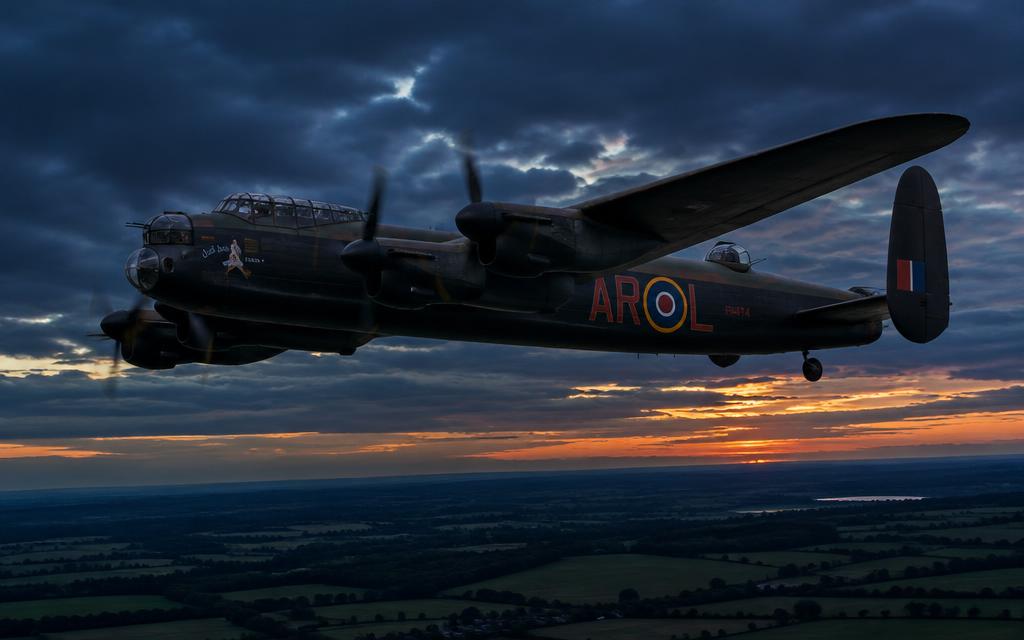
- Manufacturer
- Avro
- First flight
- 9 January 1941
- Operational debut
- March 1942
- Total built
- 7,377
From Manchester to Lancaster
The Lancaster emerged from Roy Chadwick and Avro’s efforts to overcome the difficulties of the twin-engined Manchester bomber. A redesigned aircraft with four Rolls-Royce Merlin engines offered the performance and reliability needed for heavy-bomber service. The first Lancaster flew on 9 January 1941.
Although it retained a family resemblance to the Manchester, the new aircraft’s greater power and revised wing transformed its capability. It was adopted by RAF Bomber Command as the air campaign expanded, becoming a principal British heavy bomber during the later years of the war.
Operational service
The Lancaster’s first operational sortie was a mine-laying mission over the Heligoland Bight on the night of 3–4 March 1942. In April, Lancasters took part in the low-level Augsburg raid. Much of the type’s subsequent bombing campaign over Germany was conducted at night.
A typical crew of seven included pilots and specialists responsible for navigation, bombing, wireless communication, flight engineering and defensive guns. Missions involved severe danger from fighters, anti-aircraft fire, weather and mechanical failure. The aircraft’s history includes both remarkable technical achievement and the heavy human cost of the bombing campaign, including losses among crews and civilians.
Special missions and variants
The long, largely unobstructed bomb bay allowed a wide range of loads. Modified Lancasters carried the bouncing weapon used by No. 617 Squadron in Operation Chastise in May 1943. Other specially modified aircraft carried the Tallboy and Grand Slam bombs against heavily protected targets.
Most Lancasters used Merlin engines, but the Lancaster II used Bristol Hercules radial engines. Production took place through a network of companies in Britain and Canada; Canadian-built aircraft were designated Lancaster X. In all, 7,377 Lancasters were built.
After the war
Lancasters also delivered food during Operation Manna and helped return former prisoners of war in Operation Exodus near the end of the conflict. Postwar aircraft served in reconnaissance, maritime patrol and other duties. The design also influenced Avro’s later Lincoln bomber and the Lancastrian transport conversion.
Preserved Lancasters now commemorate those who served. The RAF Battle of Britain Memorial Flight’s PA474 and the Canadian Warplane Heritage Museum’s FM213 are the best-known flying examples; actual flying availability depends on maintenance and restoration. Museum aircraft preserve additional parts of the type’s story.
What to look for
Look for four propeller engines, twin tail fins and the long fuselage with its large greenhouse-style cockpit. Most examples have slender Merlin engine nacelles; the Hercules-powered Mk II has round radial-engine nacelles. Turrets and other equipment can vary between surviving aircraft.