
Lockheed Martin F-35B
The short-takeoff and vertical-landing Lightning II combines a specialised lift system with the F-35 family’s stealth and integrated sensors.
For information on this aircraft, please click here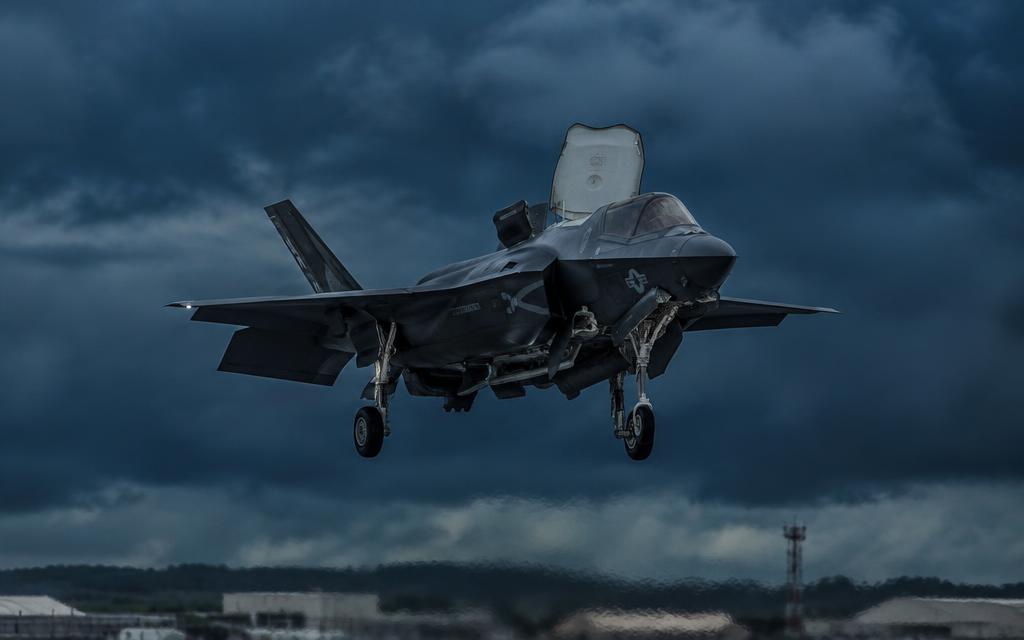
- Manufacturer
- Lockheed Martin
- First F-35B flight
- 11 June 2008
- USMC operational capability
- 31 July 2015
- Role
- STOVL multirole fighter
The Joint Strike Fighter programme
The F-35 emerged from the Joint Strike Fighter programme, intended to provide related aircraft for services with different operating requirements. Lockheed Martin’s X-35 demonstrator preceded the production design. The family includes the conventional F-35A, the short-takeoff and vertical-landing F-35B, and the carrier-oriented F-35C.
The F-35B was developed for the US Marine Corps and partner nations needing to operate from short runways or ships without conventional catapult launch systems. Its first flight took place on 11 June 2008. The B model’s lift equipment makes it a distinct aircraft within the family, not simply an F-35A with a different landing procedure.
How vertical flight works
The aircraft’s STOVL system combines an engine-driven lift fan behind the cockpit, a swivelling rear exhaust nozzle and roll-control outlets in the wings. During a vertical landing, the lift fan and redirected engine thrust support the aircraft while the control system manages balance.
In ordinary forward flight, the lift-system doors close and the aircraft flies as a supersonic jet. Operational departures normally use a short takeoff to carry a useful combination of fuel and weapons. Vertical landing capability should not be confused with routinely taking off vertically at a full operational load.
Testing and operational service
Initial shipboard trials aboard USS Wasp in 2011 demonstrated short takeoffs and vertical landings at sea. On 31 July 2015, the US Marine Corps declared initial operational capability for the F-35B, marking the availability of its first baseline warfighting capability.
In 2018 the F-35B made its first Middle East deployment aboard USS Essex. The UK’s RAF and Royal Navy operate the variant as Lightning for land-based and carrier operations, including service with the Queen Elizabeth-class carriers. Training, ship integration and continuing upgrades form a substantial part of its service history.
Sensors and continuing evolution
The F-35’s role extends beyond the visible aircraft: low-observable shaping, internally carried weapons and integrated sensors help it detect and share information. Software and equipment upgrades continue to develop its capabilities. Unlike the historic warbirds in this collection, the F-35B is an active programme whose history is still being written.
What to look for
Look for a single engine, angular fuselage and twin outward-canted tail fins. The large lift-fan door behind the cockpit is the clearest B-model clue when open. During a vertical landing, the rear nozzle points down. Keep to public viewing areas and follow local safety restrictions.